Difference Between Point Cloud Modeling and Point Cloud to BIM Modeling
Understand the difference between Point Cloud Modeling and Point Cloud to BIM Modeling to choose the right workflow for your AEC project.
With the growing adoption of laser scanning, reality capture, and digital construction, point clouds have become a foundational element in modern AEC workflows. However, many professionals still confuse Point Cloud Modeling with Point Cloud to BIM Modeling.
Although both processes start with point cloud data, their objectives, level of detail, outputs, and use cases are very different. This confusion often leads to choosing the wrong workflow, increasing cost, rework, and coordination issues on projects.
In this blog, BIM Craft Hub explains the key differences between Point Cloud Modeling and Point Cloud to BIM Modeling, helping you choose the right solution based on your project goals and long-term requirements.
What Is Point Cloud Modeling?
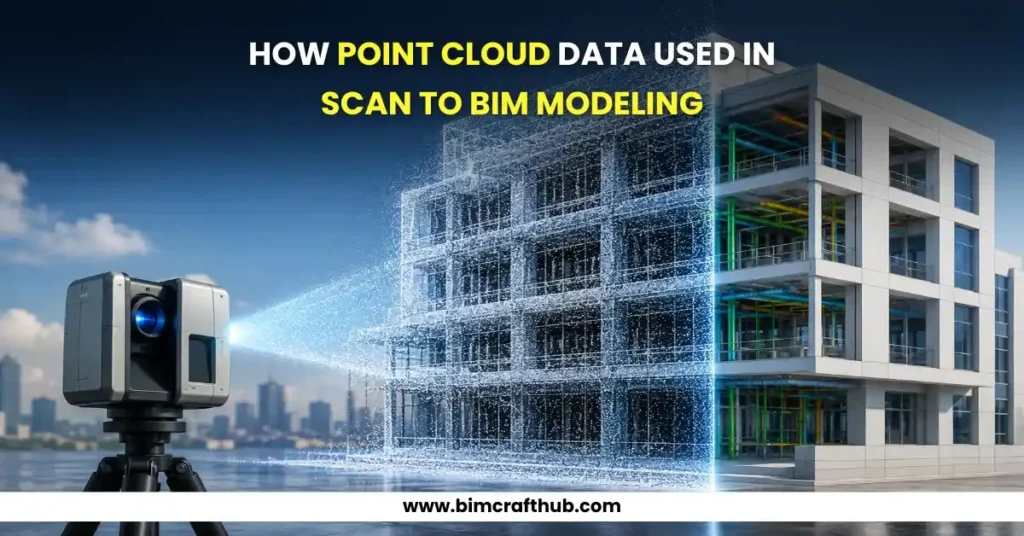
Point Cloud Modeling refers to the process of working directly with raw or registered point cloud data obtained from laser scanners, LiDAR, or photogrammetry.
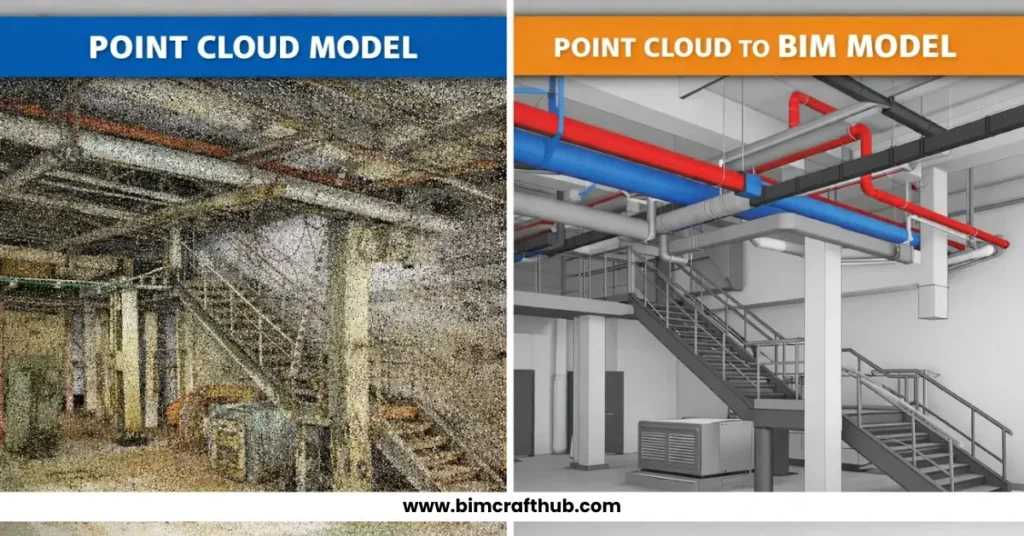
The data consists of millions or billions of XYZ coordinate points representing the physical geometry of an existing structure. It provides a realistic digital snapshot of site conditions but does not convert geometry into intelligent building elements for design or analysis.
Key Characteristics of Point Cloud Modeling
- Uses raw point cloud data
- No intelligent BIM elements
- Geometry is represented only by points
- Primarily used for visual reference and measurements
- Minimal or no parametric data
Because it lacks object intelligence and embedded data, this approach is mainly suitable for observation, verification, and basic spatial understanding rather than detailed modeling.
Typical Applications of Point Cloud Modeling
- As-built verification
- Dimensional checks
- Deviation analysis
- Construction progress monitoring
- Clash comparison against design models
These applications are generally short-term and help project teams validate existing site conditions without creating editable or data-driven models.
What Is Point Cloud to BIM Modeling?
Point Cloud to BIM Modeling is an advanced process of converting point cloud data into a fully intelligent, parametric BIM model using software such as Autodesk Revit, Archicad, or Bentley OpenBuildings.
In this process, point clouds act as a reference, and BIM elements like walls, floors, beams, columns, ducts, pipes, and equipment are accurately modeled over the scan data. This results in a data-rich digital building model.
Key Characteristics of Point Cloud to BIM Modeling
- Creates LOD-based BIM models
- Includes parametric and intelligent elements
- Supports data-rich information
- Enables multi-disciplinary coordination and analysis
- Aligns with BIM standards such as LOD 200–LOD 500
These models can be updated, shared, and reused across different project stages, making them valuable throughout the building lifecycle.
Typical Applications of Point Cloud to BIM Modeling
- Scan to BIM projects
- Renovation and retrofit projects
- Facility management and asset tracking
- Clash detection and coordination
- Digital twin creation
These use cases provide long-term value by improving design accuracy, coordination efficiency, and operational decision-making.
Major Differences Between Point Cloud Modeling and Point Cloud to BIM Modeling
1. Level of Intelligence
Point Cloud Modeling represents only geometric reality, while Point Cloud to BIM Modeling creates intelligent building elements with properties like material, thickness, and system information.
This intelligence allows BIM elements to behave like real components, supporting analysis, scheduling, and asset management.
2. Purpose & Use Case
- Point Cloud Modeling is ideal for visualization and measurement
- Point Cloud to BIM Modeling is ideal for design development, coordination, and lifecycle management
The choice depends on whether the project requires reference-only data or a functional, data-driven model.
3. Data Usability
Point cloud data alone cannot be effectively used for:
- Quantity takeoffs
- Clash detection
- Asset management
BIM models created from point clouds support all these activities, making them more valuable for contractors, consultants, and owners.
4. Accuracy & Control
Both processes are accurate, but Point Cloud to BIM Modeling ensures accuracy within defined tolerances and standards such as USIBD Level of Accuracy (LOA).
This controlled accuracy is critical for renovation, prefabrication, and coordination-heavy construction projects.
5. Cost & Project Value
While Point Cloud Modeling is generally more affordable, Point Cloud to BIM Modeling delivers higher long-term value.
The initial investment helps reduce rework, improves planning, and supports efficient facility operations over time.
When Should You Use Point Cloud Modeling?
Choose Point Cloud Modeling when:
- You need quick site reference
- Only basic measurements are required
- Budget constraints are a concern
- No design development or coordination is planned
It is best suited for early-stage verification or limited-scope analysis tasks.
When Should You Use Point Cloud to BIM Modeling?
Choose Point Cloud to BIM Modeling when:
- Renovation or retrofit work is involved
- Accurate as-built BIM models are required
- Multi-disciplinary coordination is needed
- Facility management or digital twin development is planned
This approach supports long-term project success beyond the construction phase.
Why Point Cloud to BIM Is the Future of AEC
As the AEC industry moves toward digital twins, smart buildings, and lifecycle BIM, Point Cloud to BIM Modeling plays a key role in connecting existing conditions with digital workflows.
It transforms raw scan data into actionable intelligence, enabling better decisions, reduced rework, improved collaboration, and long-term asset value.
How BIM Craft Hub Can Help
At BIM Craft Hub, we specialize in:
- Point Cloud Processing
- Scan to BIM Conversion Services
- LOD 300–LOD 500 BIM Modeling
- Architectural, Structural & MEP BIM
- Clash Detection & Coordination
Our experienced BIM professionals deliver accurate, standardized, and cost-effective Point Cloud to BIM solutions for global AEC projects.
Contact BIM Craft Hub today to transform your scan data into intelligent, reliable BIM models.
Conclusion
Although Point Cloud Modeling and Point Cloud to BIM Modeling start with the same scan data, they serve very different purposes.
- Point Cloud Modeling = Visual and measurement reference
- Point Cloud to BIM Modeling = Intelligent, data-rich digital building
Understanding this difference helps project stakeholders invest in the right workflow and achieve better project outcomes.
Share on: